
Chinese robot dog fiasco in AI Summit: Galgotias University asked to Vacate
February 18, 2026 12:59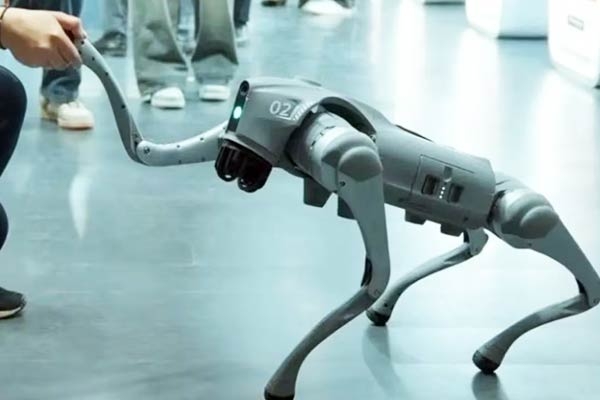
(Image source from: News18.com)
Galgotias University, located in Noida, was instructed on Wednesday to leave the India AI Impact Summit right away after a situation arose regarding the university showcasing a Chinese robodog as its own, according to sources. This decision followed significant backlash the university received on social media after the robotic dog, which was shown at its booth as a creation of the institution, was discovered to be a product from China that is available on the market. Although the university insisted that it never stated it had created the machine, it initially claimed that it had not received any orders to vacate. Nonetheless, India Today confirmed that Galgotias was indeed leaving its spot at the AI Summit Expo taking place at Bharat Mandapam in New Delhi. This incident left the government embarrassed after the opposition accused it of allowing the showing of "Chinese products" at the India AI Summit. The issue arose when Galgotias University presented a surveillance robot dog called "Orion" at the AI Summit in Delhi. A widely shared video features a university professor, Neha Singh, showcasing the robodog and asserting that it was developed through the university's Rs 350 crore AI project.
She mentioned proudly that the robodog could perform surveillance while independently moving around the campus. The device gained more attention when it appeared in a video titled India's 'Sovereign Models,' shared by Union Minister Ashwini Vaishnaw. However, it turned out that the robot dog was actually a Chinese product named Unitree Go2 and not an innovation created by the university. The Unitree Go2 is a readily available, mass-produced robodog that can be purchased for around $2,800 (Rs 2.3 lakh). Unitree is a robotics company from China known for manufacturing these advanced four-legged robots that can move similarly to real dogs while performing monitoring tasks. It seems that Galgotias did not conduct adequate research or thought it would not be scrutinized. In the era of social media, this is a rather naive assumption.
As the situation escalated, the university quickly released a statement. The university declared that it had never claimed to have created the robotic dog and that it was being utilized for educational purposes. "Let us be clear - Galgotias has not built this robodog, nor have we claimed. . . Our students are experimenting with it, testing its limits, and in the process, expanding their own knowledge," the statement mentioned. However, further embarrassment followed for Galgotias. The university's clarification was contested by a community note on X. This note argued that the university's claim of not presenting the robot as its own was false. It stated that during their presentation at the AI Summit, the robot was explicitly referred to as developed by the university.
A X account tied to China shared a claim from the university. "An Indian university showcases the Chinese robot Unitree Go2 as its own creation at the AI Summit in Delhi," the message stated. Presenting a product from China as a homegrown achievement at an international summit with foreign officials and tech leaders could harm the country's reputation. On Wednesday, Galgotias tried to manage the fallout and sent its professors to speak with the press. They now want to frame the situation as a misunderstanding. Neha Singh, who has unintentionally become the center of the debate, mentioned that the issue arose due to poor communication. "I accept responsibility for possibly not conveying it correctly. Also, the purpose might not have been clearly understood. An important detail is about the robot dog - we cannot say that we created it," Singh explained.
Nitin Kumar Gaur, registrar of Galgotias University, has directly blamed Professor Neha Singh.
"This is a mix of two terms, develop and development. We didn’t create it. We contributed to its development. . . I can say that maybe she (Professor Neha) was a bit confused by the terms used," Gaur told ANI. This whole situation has caused many social media users to doubt the university's credibility. A research paper from 2020 related to Galgotias that made controversial statements suggesting sound vibrations could eliminate Covid has come back into focus amid this issue. It will be interesting to see how the university resolves the problems it has caused for itself.